Text
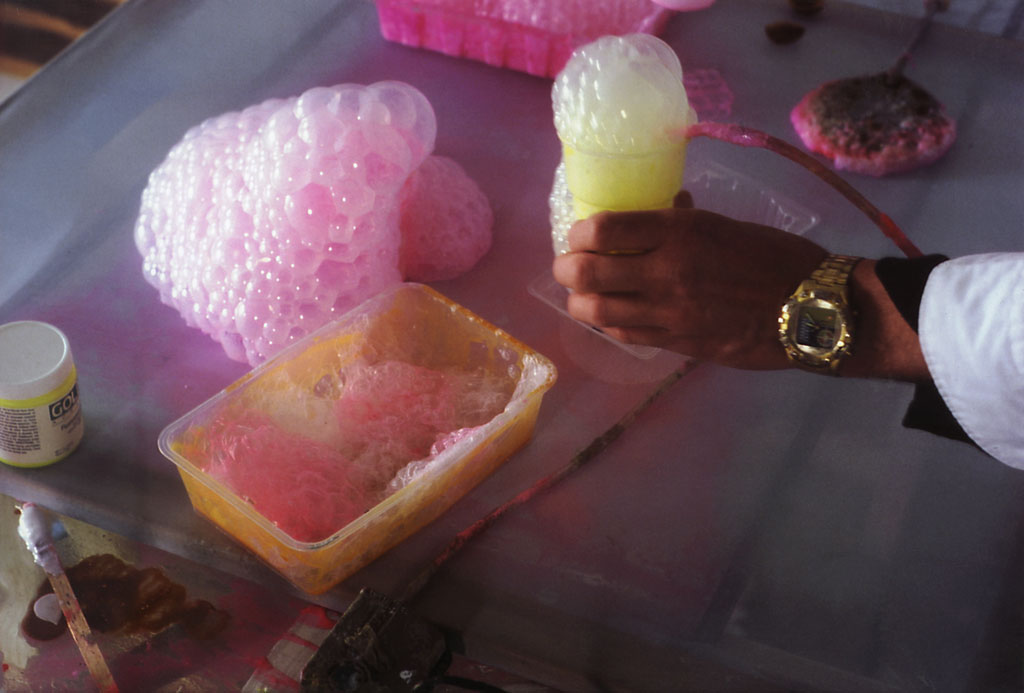
How is this work made?
I am a material realist, the brushstrokes of acrylic that I use are prefabricated on a glass plate and then,
where necessary, applied to the canvas.
If they do not suit, they are immediately removed from it, a form of analogue photoshopping.
Let's say “there are plenty brushstrokes in the sea”

I feel more like a musician in which all notes (brushstrokes) remain autonomous,
yet together they form a harmonious whole, provided with the necessary dissonances ".
___________________________________________

Why this method?
Unlike the use of paint in the classic painting, the material, the paint, does not represent anything else,
it remains a thing, a product, a brushstroke.
It is not primarily in the service of color and form, as in modern painting, but is much more present because of itself.

Because of my collage-like way of working with many layers of synthetic resin, acrylic and other plastics,
my paintings are rather spatial in nature.

The craftsmanship and, more generally, the combination of contemporary technologies,
objects and materials are at work in my search for stimulation, direction and seduction of the painting.

Hans Walraven 2018


_________________________________________________________________________________________________________
Hoe wordt dit werk gemaakt?
Ik ben een materiaalrealist, de verfstreken van acryl die ik gebruik worden prefab gefabriceerd op een glasplaat en daarna, daar waar nodig, op het canvas aangebracht. Voldoen ze niet dan worden ze er zonder pardon weer van afgetrokken, een vorm van analoog photoshoppen. Voor iedere verfstreek tien anderen zullen we maar zeggen.
Ik voel me meer een muzikant waarbij alle noten (verfstreken) autonoom blijven, en toch samen een harmonisch geheel vormen, voorzien van de nodige dissonanten”.
__________________________________________
Waarom deze werkwijze?
Anders dan verfgebruik in het klassieke schilderij beeldt het materiaal, de verf, niet iets anders uit, het blijft nml. een ding, een product, een verfstreep dus. Het staat ook niet in de eerste plaats in dienst van kleur en vorm, zoals in het moderne schilderij, maar is veel meer aanwezig omwille van zichzelf.
Door mijn collageachtige manier van werken met de vele lagen kunsthars, acryl en andere kunststoffen zijn mijn schilderijen tamelijk ruimtelijk van aard.
De ambachtelijkheid en, meer in het algemeen, de combinatie van hedendaagse technologieën, objecten en materialen staan in dienst bij mijn zoektocht naar prikkeling, sturing en verleiding van het schilderij.
Hans Walraven 2018